What Causes Microbust Storms?

Note: This entry was initially written for Level 2 cadets at the 540 Golden Hawks Squadron. See other posts in this series.


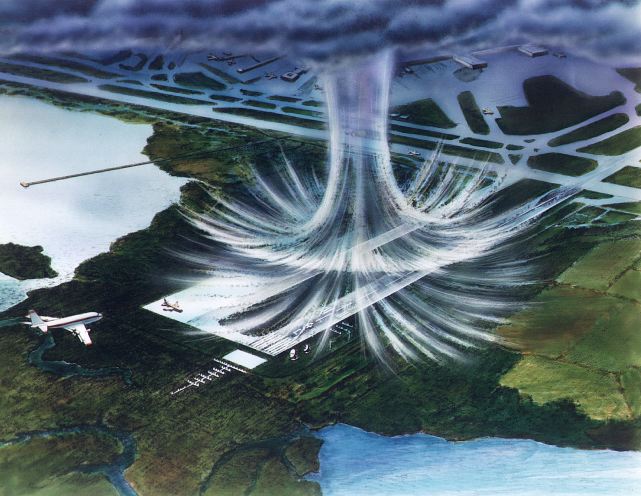
An interesting weather phenomenon known as a “wet microburst”. which is when a lot of rain falls in a very small area, which causes a lot of winds as a result. These can look very cool, but are very dangerous to fly through!

Wet microbursts are a type of “downburst”, which happen during thunderstorms. A downburst is anytime cool air is forced out of a storm in a smallish area; if that air also has rain in it, and if the downburst is smaller than 4 kilometers in diameter, it becomes a “wet microburst”.

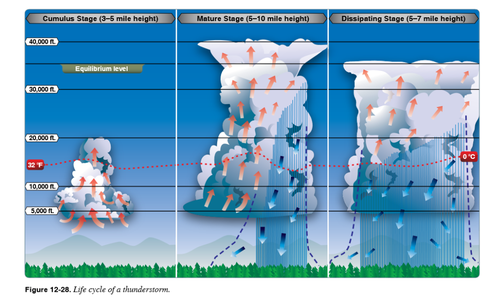
One way to think about thunderstorms is that they first need to “breathe in” by taking in warm air from the ground; and then as the warm air is cooled at high altitudes, the storm “breathes out” the cool air.

If the “breathed in” air is humid enough, and the high altitude air is cold enough, precipitation forms—which means the “breathed out” air can be either rain or hail. (This is why hail mostly happens in the spring.)

Thunderstorms — ANAC National Civil Aviation Agency - Brazil
Clouds first “breathe in” warm air, get bigger, then “breathe out” cold air and precipitation. Picture from the National Civil Aviation Agency of Brazil: https://www.anac.gov.br/en/safety/aeronautical-meteorology/conditions/thunderstorms

Most of the time, storms take in a “deep breath”, forcing the air to very high altitudes which also causes it to spread out, and then “breathe out” over large areas.

But sometimes, especially after a hail storm where the melting ice forms an area of much cooler air, the breathing out process starts much earlier—at both a lower altitude and before the air has had a chance to spread out over the sky.

This is what causes a downburst, and in effect it’s like dumping a huge bucket of water (or heavy air) from the heavens unto the earth. With gusts of wind that can travel up to 240 km per hour, you want to be very far away from one!

The RDA of Vitamin D is based on bad statistics

Vitamin D has been in the news lately, especially for its beneficial effects on immunity (as well as other benefits), and its potentially beneficial effects in preventing the development of COVID-19.

So how much vitamin D should a person be getting every day? The “recommended daily allowance” suggested by the Canadian and American nutrition authorities is 600 “international units” (equivalent to 15 micrograms).

A Brief History of the Modern RDA

Where did those RDAs come from? The answer is a 2011 report published by the Institute of Medicine (IOM), called the Dietary Reference Intakes for Calcium and Vitamin D. It determined that Americans and Canadians require a daily vitamin D intake of about 600 IU per day by analyzing 32 studies of vitamin D supplmentation.

Their findings are explained and graphed in Chapter 5 of their report, pages 380-383 and figure 5-3. They claim that by supplementing with 600 IU of vitamin D per day, 97.5% of people will achieve adequate levels of vitamin D.

Continue reading “The RDA of Vitamin D is based on bad statistics”

Bicycles are Bullshit

No one should have to live like this.

Over the past few years, many “urbanists” have taken to advocating for bicycle supremacy.

They demand existing urban and suburban roads be narrowed to make way for bicycle lanes; that new infrastructure be provided for the exclusive use of bicycles; the demolition and prohibition of public parking lots; and that the rest of us be forced via increased taxes, fees, and a public shaming campaign to change our car-driving ways.

Enough is enough. As someone who hasn’t ridden a bicycle since earning my driver’s license 15 years ago, I’m choosing to fight back against what I am calling the cycle supremacists.

Bicycles, and cyclists generally, should be shunned for four reasons. Here they are:

Continue reading “Bicycles are Bullshit”

The Impossibility of Economic Calculation, in One-Syllable Words

More economics in one-syllable words, this time Economic Calculation in the Socialist Commonwealth by Ludwig von Mises. Here is a two-paragraph summary:

Cash is the one thing that all of us in the world want. This trait of cash is what lets us use it with math: if the cash I pay to build a good is less than the cash I will get when I sell it, I can make the choice to build the good in a clear way. For cash to have this trait, though, it must trade among all goods in the world, and each trade must be a free choice. This way, each price lets us know how much a thing is worth to all the folks in the world.

But in a world where all a large chunk of the goods are owned by one group, then that group can’t trade what it owns with things that it also owns to get a cash price. It would be mad. Since these goods can’t be priced in cash, we can’t know how what they’re worth to the world! Thus, to use math to learn if our yield to build a thing is good or bad would be vain. This is bad!

And a longer, section-by-section summary of the whole essay:

Continue reading “The Impossibility of Economic Calculation, in One-Syllable Words”

Forget about the second wave of the virus, get ready for a recessionary tsunami

Originally published at the Hill Times.

In the midst of multi-phase re-opening plans, Covid-19 cases are back on the rise around the world. This has caused talks of a second round of lockdowns to circulate before this first round of unlocking. This is music to the ears of struggling business owners. Yet we shouldn’t expect a government-orchestrated economic plan to be harmonious. The new normal for businesses will still mean a cacophony of higher input prices and disrupted distribution networks. 

Finance Minister Bill Morneau’s fiscal snapshot delivered Wednesday predicts a very sharp recovery in GDP, with a gentle tapering of unemployment. This is a bad prognosis. With or without a second round of lockdowns, the economy will fall sharply ill again. Simply put, the global economy of the past few months has produced less stuff to use in trade, production, and manufacturing. What makes it worse is that these disruptions have happened at the arbitrary whim of bureaucrats. Even if demand returns to pre-Covid levels tomorrow, businesses may not be able to support their existing workforces or capital structure. 

The invisible hand of supply and demand will soon be greeting the market not with a socially distant salute; but rather with an invasive groping of revenue streams and supply chains. Investors and business owners must prepare for the worst. Expect more layoffs, store closures, and bankruptcies, as entrepreneurs unmask what the new normal will look like.

Politicians themselves will never admit to these problems. Many will tout that their decision-making has been prudent and shrewd, as they’ve been seeking expert advice. Officials tell us to expect the economy to bounce right back, even though these advisors are not economists themselves. Whether the recovery will look like a “V” or “U”, we should seriously question the alphabet soup of optimism that we’re being told to swallow. 

Foremost: politicians have no objective measure for determining what is and isn’t essential. The global supply and distribution system is, quite literally, unimaginably complex. The metaphor of a supply “chain” is misleading, as it implies a clear beginning and end. Since what may be a consumption good for one person may be a capital good for another, it’s more accurate to talk about an economic crochet—an intricate interweaving of supply threads and demand threads, coming together in an ever growing pattern of commerce. Plucking away at random threads may seem harmless at first, but it fundamentally alters the structural integrity of the whole economy. 

The impacts are already being felt. Scholars estimate an increase of over 253,000 cases of infant mortality this year due to the global lockdowns (compare that number to 550,000, the worldwide death total of Covid-19). 

Between overloaded mental crisis hotlines, deferred cancer testing and treatment, an increase in domestic abuse, disruptions in supplying pharmaceuticals, and a global food supply crisis that the UN’s World Food Programme says could lead to 270 million people being “acutely food insecure”, it will be years until the full effects of these lockdowns will be reckoned with. 

Governments around the world have been almost uniform in their response: hand out money to seemingly anyone who asks for it. Where did all this money come from, in a time when many are working and earning less? The central banks. Yet printing money to prop up financial assets devalues the currency overall. Ultimately, all of us will be forced to pay higher prices for everyday goods and services. 

Although this pandemic is novel, the laws of economics remain unchanged. Prices are determined by supply and demand, and enterprising individuals will find a solution to anything profitable. Understanding these principles will be the key to a healthy prognosis for recovery. The only complication to worry about is more meddling by politicians, which has a simple cure: civic vigilance.  
Mises’ Bureaucracy, in One-Syllable Words

Bureaucracy, by Ludwig von Mises, summarized in one-syllable words:

Folks on both the left and the right claim to hate the thing this book is named for.

The word has a rude tinge to it. Folks gripe that they are slow, with lots of faults in how they’re run. And look who they’re run by: lots old guys . “We want change,” they say.

But no change comes. Strange, right?

So do these folks even know what it is that they’re mad at? I don’t think they know. But I know what’s got their goat. Read on to find out.

Continue reading “Mises’ Bureaucracy, in One-Syllable Words”

Human Action in One-Syllable Words

Human Action by Ludwig von Mises — in one-syllable words (inspired by the summaries of famous philosophical works by Jason Brennan). Here is a short summary, before launching into a part-by-part treatment:

You can choose. With this true face, we can use just our wits to learn some more true facts: like you act in time, you have doubt about fate, and that you give up your least liked piece of a thing to get more of what you want. If you live with a group that you trade with, you should each own the goods you use to make things with and trade them for cash. The cash math will help with your growth plans. If you don’t, your group will break and rot. If any bank makes fake cash and lends it out, it will cause a boom and bust. Folks are blind to these facts; you must help them see.

Continue reading “Human Action in One-Syllable Words”