The Nonfiction Story Circle

What can nonfiction writers learn from writers of fiction? In my view, the answer is how to quickly and efficiently write something using structure.

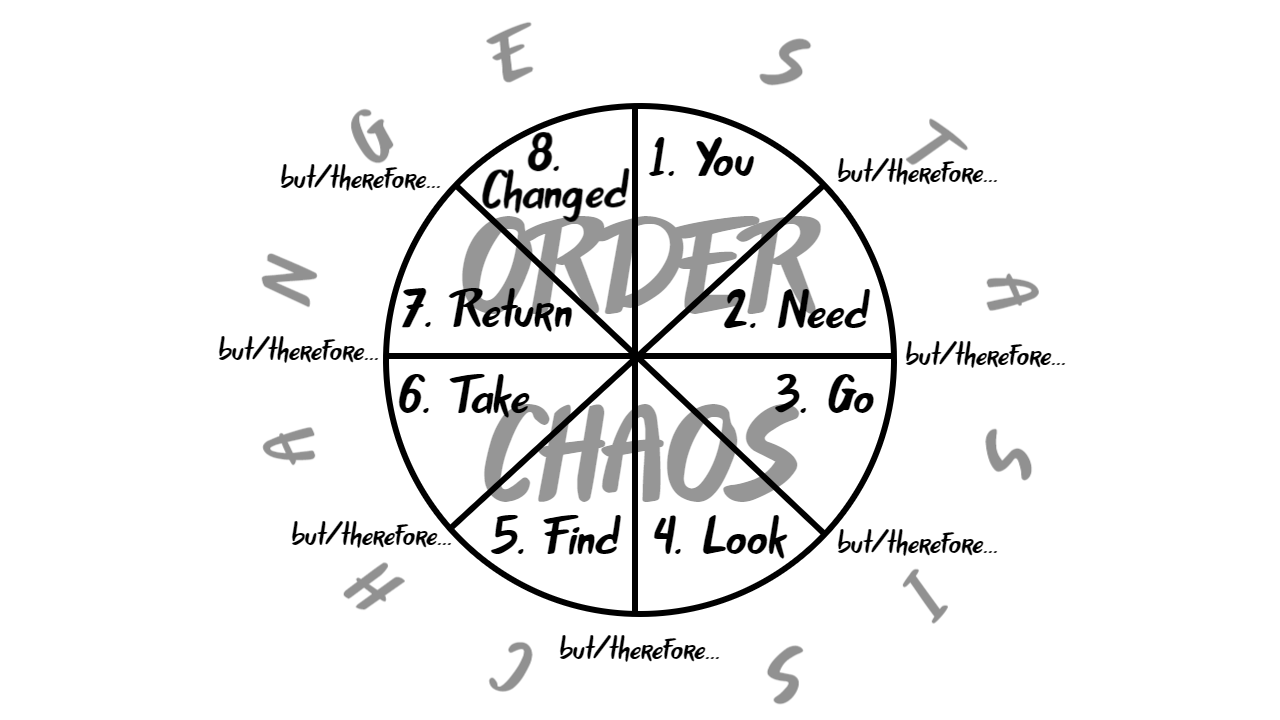
Dan Harmon’s “story circle” is a popular framework for structuring fiction writing, from short stories to screenplays. It is a simplification of the better known Hero’s Journey, and Harmon has famously used this framework to aid his writing process for Community and Rick & Morty. 

In Harmon’s view, all stories are “circular” in that they are about starting from somewhere familiar, going somewhere unfamiliar, and then returning with some lessons learned. This can be broken down to 8 simple words: You, Need, Go, Search, Find, Return, Changed. This framework is very popular, and has been applied to analyze many other works of fiction (see, for example, here and here).

However, this original framework lacks natural transitions between each stage. This makes it easy for This is where Trey Parker and Matt Stone’s idea of connecting story beats with either a “but” or a “therefore” is really powerful. (The opposite of but/therefore is “and then”—which indicates a list of chores, not anything logical or structured.) 

In a previous post, I combined these ideas in what I called the “But-Fore Story Circle”. 

Continue reading “The Nonfiction Story Circle”

Jordan Peterson Was Not “Addicted to Benzos”

In late 2019, Jordan Peterson went on an extended absence from public life. In a series of videos on his and his daughter Mikhaila Peterson’s YouTube channels (1, 2, 3, 4), it eventually became clear that he was suffering side effects from taking benzodiazepine medications (commonly known as “benzos”).

Despite the extreme detail the videos went into, the press reported these events in an incorrect and misleading manner. The most common headline and talking point became that Jordan Peterson was “addicted to benzos.” The reports later embellish this claim by declaring that Peterson was taking benzodiazepines to treat his anxiety.

Peterson was never “addicted” to benzos. He developed a physical dependency to them. There is a difference between these terms.

Continue reading “Jordan Peterson Was Not “Addicted to Benzos””

The “Liberty Fund Rules” For Seminars and Discussions

Introduction

I am currently in a reading group on the Leo Strauss book On Tyranny, which also features essays by Alexandre Kojève. We just wrapped our first online discussion of the book, and it inspired me to write this post.

One of my fondest memories as a student was attending more than a dozen invite-only seminars on economic and political theory, which ranged from an afternoon to a full week. These were times when I got to spend time with some of the smartest students and scholars from around the world, to spend hours and delving deep into specific books, articles, and other intricacies of thinking, writing, and debate.

Continue reading “The “Liberty Fund Rules” For Seminars and Discussions”

Narrative Structure Equivalence Chart

There are many ways to structure a story. But one theory says that they are all really saying the same thing.

Here I create a table comparing the four major narrative structures: Aristotle’s chronological structure, John Campbell’s Hero’s Journey, Dan Harmon’s Story Circle (the source for my “But-Fore Story Circle“), and the classic three-act play.

I’ve also included two other structures, which aren’t normally considered part of dramatic storytelling. First is something I call “MMO”, which stands for means, motive, and opportunity. This is how typically how detectives determine who is the perpetrator of a crime. Second is “Human Action”, Ludwig von Mises’s title for his treatise on economics (I wrote a one-syllable summary here); it is a theory of how basic principles of choosing can be used to explain all economic phenomena.

Chronological Hero’s Journey Story Circle Three ActsMMO (detective principles)Human Action (economic theory principles)
Beginning Call to adventure You. Need. Go. Setup Motive Prerequisites of action: felt unease about the current state of affairs, ideas about a possible better world, and a logical connection between ends sought and means required to instigate the change to get them
Middle Challenges and transformation Look. Find. Take. Confrontation Means Entrepreneurial judgment: whether the benefits of change outweigh the costs 
End Atonement and return Return. Changed. Resolution OpportunityAction: making the choices necessary to bring about the desired state of affairs: exchanging with oneself and others to alter the structure of production. 

The But-Fore Story Circle

What can Rick and Morty and South Park teach about writing a good story? Combining elements from the writing advice from the creators of both shows, I’ve devised a new way of structuring stories quickly and efficiently. In short, it is Dan Harmon’s story circle, with a logical transition between each stage: either a “but” or a “therefore”—a trick I learned from Matt Stone and Trey Parker, the creators of South Park.

The “But-Fore” Story Circle.

I explain the reasoning behind the But-Fore Story Circle in more detail below.

Continue reading “The But-Fore Story Circle”

Axiomatic Psychology

Can we have an axiomatic theory of psychology?

A bit of background: since at least the time of Spinoza, up until the present day, a limited number of people have made attempts at creating an axiomatic approach to understanding and studying the human psyche.

They have all failed to gain any traction or respect. The most likely reason, in my assessment, is quite simply having way too many axioms.

An axiom is supposed to be a clear, “self-evident” truth, from which one can then logically derive other truths. The most famous use of axioms is by Euclid, where he used 5 very simply stated axioms (like “The whole is greater than the part”) to derive a few hundred pages of geometry. Modern mathematical economics also uses a handful of axioms, while the Austrian economist Ludwig von Mises only required one axiom (“Human action is purposeful behavior”) to understand the world.

However, modern attempts at axiomatizing psychology include dozens of axioms. For example, the “pyscho-logic” approach has over 50 axioms. What’s worse, is that many of these axioms have been expressed mathematically.

To me, this is unnecessarily complicated analysis. So below, I have attempted to give a start to a new kind of axiomatic psychology, using only one axiom:

Axiom: Thinking is the ability of a brain to observe, analyze, and decide.

Continue reading “Axiomatic Psychology”

The RDA of Vitamin D is based on bad statistics

Vitamin D has been in the news lately, especially for its beneficial effects on immunity (as well as other benefits), and its potentially beneficial effects in preventing the development of COVID-19.

So how much vitamin D should a person be getting every day? The “recommended daily allowance” suggested by the Canadian and American nutrition authorities is 600 “international units” (equivalent to 15 micrograms).

A Brief History of the Modern RDA

Where did those RDAs come from? The answer is a 2011 report published by the Institute of Medicine (IOM), called the Dietary Reference Intakes for Calcium and Vitamin D. It determined that Americans and Canadians require a daily vitamin D intake of about 600 IU per day by analyzing 32 studies of vitamin D supplmentation.

Their findings are explained and graphed in Chapter 5 of their report, pages 380-383 and figure 5-3. They claim that by supplementing with 600 IU of vitamin D per day, 97.5% of people will achieve adequate levels of vitamin D.

Continue reading “The RDA of Vitamin D is based on bad statistics”

Bicycles are Bullshit

No one should have to live like this.

Over the past few years, many “urbanists” have taken to advocating for bicycle supremacy.

They demand existing urban and suburban roads be narrowed to make way for bicycle lanes; that new infrastructure be provided for the exclusive use of bicycles; the demolition and prohibition of public parking lots; and that the rest of us be forced via increased taxes, fees, and a public shaming campaign to change our car-driving ways.

Enough is enough. As someone who hasn’t ridden a bicycle since earning my driver’s license 15 years ago, I’m choosing to fight back against what I am calling the cycle supremacists.

Bicycles, and cyclists generally, should be shunned for four reasons. Here they are:

Continue reading “Bicycles are Bullshit”